
Review · KRAKOW GOLF CART & ELECTRIC CAR TOURS
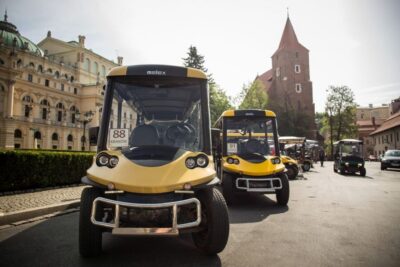
Krakow: City Sightseeing Tour Eco Electric Buggy Golf Cart
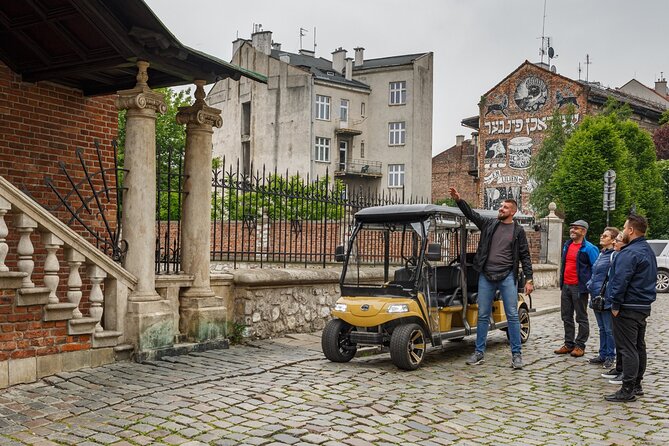
Kraków’s Jewish quarter is easier from a buggy. In 90 minutes, you get pushed to and pointed toward nearly 24 sights, from Church on the Rock to Podgórze, with stop by stop context. I also like the comfort factor, heated buggies with blankets that keep a cold day from turning miserable.
One drawback to consider is that rides can feel a bit bumpy, and on packed departures you may get less personal space than you want. If you are sensitive to that, pick an earlier time slot if you can, and ask questions right away if the group feels tight.
The guides stand out in the reviews, with names like Olivia, Jacob, Natalie, and Oskar showing up again and again for clear explanations and a calm, respectful tone, especially around the ghetto sites. You also get an audio guide layer, so you are not stuck only listening to the driver as you roll between places.
Key things to know before you go
• Near 24 stops in 90 minutes, a fast way to get bearings across districts
• Heated carts and blankets make a winter ride actually pleasant
• Kazimierz synagogue circuit includes major names you will recognize later
• Ghetto Heroes Square and the Eagle Pharmacy Museum add real context on the dark years
• Small-ish group setup (max 50 total), but carts can still get crowded
• You see a lot from the cart, but not every site may have interior access
Meeting point, timing, and how this buggy tour feels
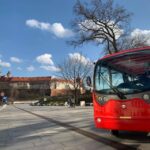
This is a 1 hour 30 minute tour that starts and ends at the same place, so you are not doing an awkward “drop off in the middle of nowhere” situation. The start point is Parking 24H Kraków old town car park, at Mikołaja Zyblikiewicza 2 (31-029 Kraków). The simplest trick I recommend from what people have shared is to use the busy main street nearby as your anchor, then walk over to Zyblikiewicza Street and look for the pickup spot across from a Zabka shop.
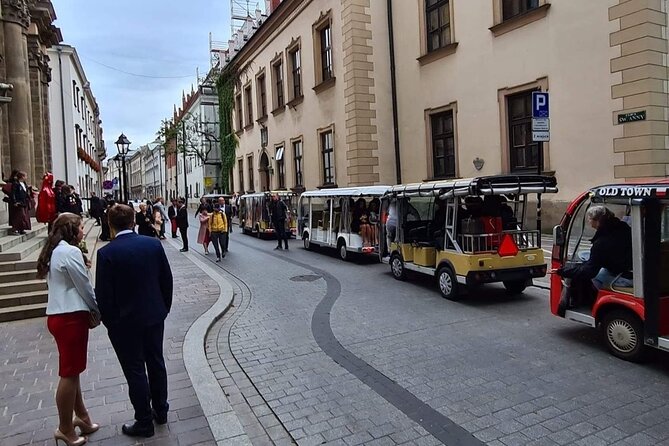
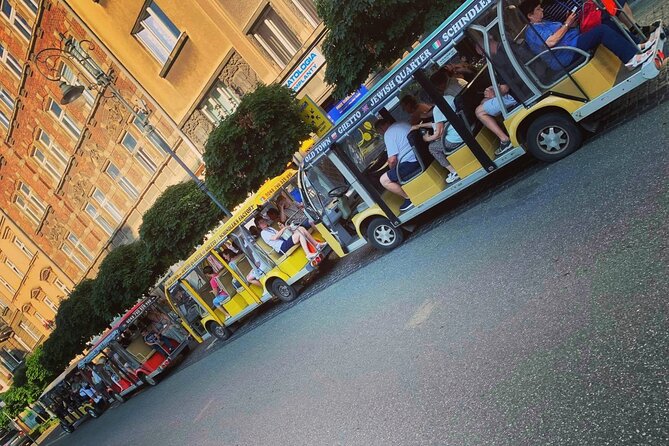
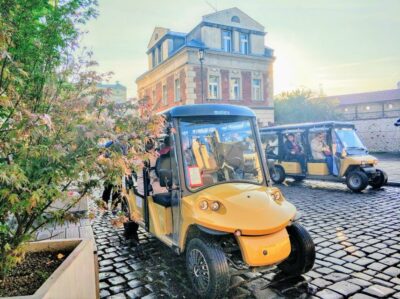
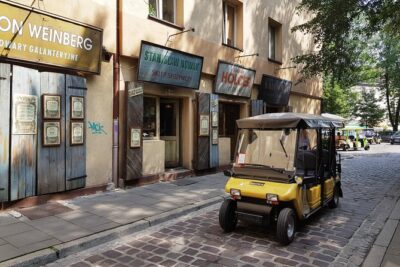
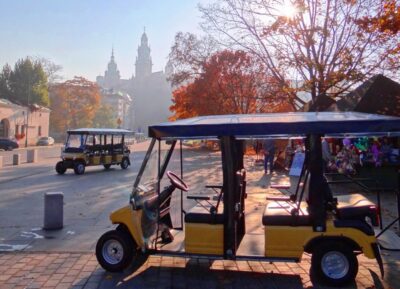
The ride itself is the point. You’re in an eco electric buggy or golf cart style vehicle, and you move through the city without the constant stop and start of walking. On a long trip day, that matters. It also matters if your legs are tired from stairs, museums, or a full day in Kraków’s Old Town.
In winter, comfort gets real. Reviews repeatedly call out blankets and heating, and that is not a minor perk if you are going when it is cold. Yes, you might still feel the chill outside between stops, but at least you are not shivering the whole time.
Expect a group setting, and expect the ride quality to vary a bit. One review mentions a bumpy feeling. Another mentions the cart being very packed, with earphones reported as not working for some people. So if you are choosing the tour for comfort, aim for a departure time that you can make early in the day.
You can also read our reviews of more city tours in Krakow
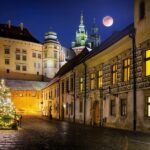
Church on the Rock, Skałka: an early hit before Kazimierz
The tour kicks off at Church on the Rock, also known as Skałka, the basilica on the little rocky outcrop with the Pauline monastery. You get a quick, meaningful orientation to Kraków’s spiritual and political past right away, including the story tied to Saint Stanislaus. You also get good value here because admission is listed as free, at least for the entry ticket associated with this stop.
Even if you are not a “church architecture person,” this first stop is a smart way to start. The setting is memorable, and it gives you a historical lens before the tour drops you into Kazimierz, where the layers of Kraków’s identity are more visible.
A quick practical note: since this is an early stop and you are still settling in, use this moment to check your audio device or headsets if you are using them. That way, the later synagogue stops do not get swallowed by technical fuss.
Kazimierz basics: Plac Wolnica and a monastery church built in stages
From Skałka, you roll into Kazimierz, the historic district that feels like a second city inside Kraków. One stop centers on the market square area of Kazimierz, specifically Plac Wolnica. This square has roots in the original market square plan for the city of Kazimierz, founded in 1335. The story here is not just “pretty square.” It is trade, administration, and the idea of freedom in commerce, with the name Plac Wolnica tied to the Latin Forum liberum, free trade conditions.
Next comes a major church stop described as a monastery church built in stages from about 1340 into the mid 15th century. It also includes the detail that it has a monastic cemetery next to it, plus the historical shift in 1404 when King Władysław II Jagiełło gave it to the Canons Regular of the Lateran. I like this part of the route because it breaks up the synagogue-focused flow with a different kind of power, the church as an institutional anchor.
After that, you get rolled through another Kazimierz setting that was once part of a larger street complex called Libuszhof. The current street shape is tied to planning projects from 1808 and 1844, and the description includes how the houses along the defensive walls of Kazimierz used to belong to the Jewish hospital associated with the Kupa synagogue. That is the kind of detail I appreciate on a short tour, because it tells you you are looking at a living neighborhood, not just “stops on a list.”
Synagogues in Kazimierz: what each stop helps you notice
This section is why many people book the buggy tour in the first place. You get close enough to understand scale and location, and you learn enough to recognize what you are seeing later if you want to return on foot.
Here’s how each synagogue stop works as a learning moment:
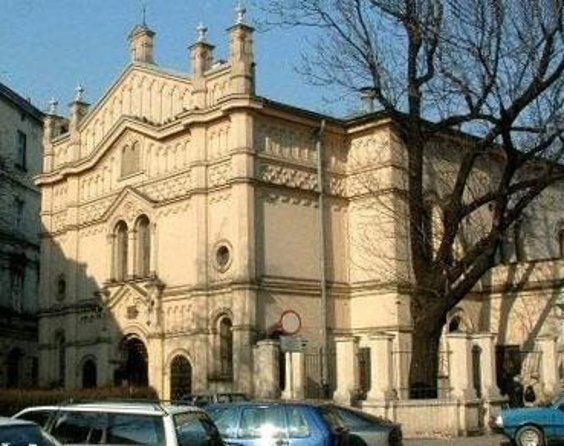
Tempel Synagogue
Tempel Synagogue is presented as a major place of worship and a cultural hub, hosting concerts and meetings, especially during the Festival. This is useful because it counters the idea that historic synagogues are only about the past. You’re learning that Kazimierz functions as a community space.
Kupa Synagogue
Kupa Synagogue is a 17th century synagogue serving Kraków’s Jewish community for religious ceremonies and cultural festivals, including the annual Jewish Culture Festival. If you want a quick understanding of what makes Kazimierz matter beyond memorial visits, this is a good anchor.
Izaak Synagogue
Izaak Synagogue, also called the Isaak Jakubowicz Synagogue, is identified as Orthodox Jewish and dating to 1644. It is named for Isaac the Rich, a banker to King Ladislaus IV of Poland, and the architecture credit is given to Italian born architect Francesco Olivierri. I like this stop because it adds names and people, not only dates.
High Synagogue, the Tall Synagogue
High Synagogue is described as inactive, dating to the 16th century, and also known as the Tall Synagogue. The tour notes that it is the tallest synagogue in the city and an example of Late Renaissance architecture. If you are the type who only half notices buildings at street level, this is the one that helps you “see” from the cart.
Old Synagogue (Stara)
Old Synagogue is called the oldest synagogue building still standing in Poland, and it served as one of the most important landmarks of Jewish architecture in Europe. The key timeline fact offered is that until the beginning of World War II in 1939, it was the main religious, social, and organizational center of Kraków’s Jewish community. This is a stop that lands with weight, even if you just look and listen briefly.
Wolf Popper Synagogue
Wolf Popper Synagogue is tied to its founder, Wolf “The Stork” Popper, in the early 17th century. The description includes the entrance decoration with openwork doors showing four animals, meant to symbolize traits of a devout man. It also notes that today it operates as a bookshop and an art gallery in the women’s area upstairs. That modern use matters, because it shows continuity, not just ruin.
Augusta Rubinstein stop
A short stop is linked to Augusta Rubinstein, an important Polish Jewish figure described through family details and her relationship to well known names like Martin Buber. This is the kind of pause that makes history feel personal. You come away remembering that real people lived ordinary lives too.
Remah Synagogue
Remah Synagogue is described as the smallest historic synagogue in the Kazimierz district and named after Rabbi Moses Isserles, using the acronym ReMA. It is also stated to be one of two active synagogues in the city. This is a helpful closing note for the synagogue cluster because you end on something you can picture continuing into today.
If you want a practical strategy for this long synagogue segment: keep your phone free for quick photos from your seat, then pick one or two synagogues to study on your return. The cart keeps you moving; it does not replace a slower walk.
Ghetto Heroes Square: moving from architecture to memory
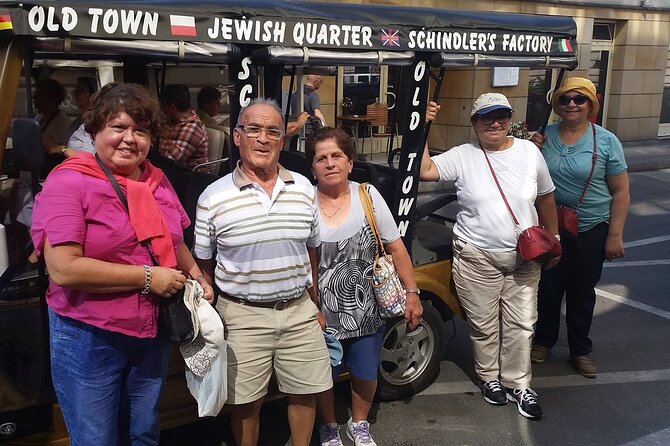
After Kazimierz, the tour shifts into Podgórze, and the message gets darker. Ghetto Heroes Square is tied directly to the Kraków ghetto era, specifically 1941 to 1943. It is described as a place where Jewish people were concentrated before being transported to concentration camps.
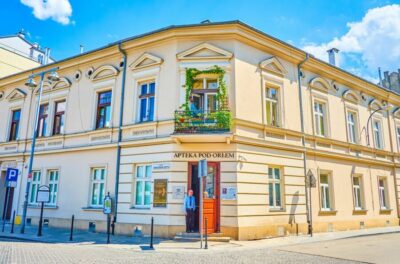
The stop includes a very specific detail at number 18, the pharmacy called Under the Eagle by Tadeusz Pankiewicz, described as the only non Jewish inhabitant in the ghetto. I find that specificity matters. It helps you avoid floating abstractly in a tragedy you cannot measure.
This is also where the tour’s tone matters, and this is one reason people rate the guide style so highly. Several reviews highlight that the guide handled the information sensitively, and on this portion of the route that respect shows.
The Eagle Pharmacy Museum: one name you will remember
The Eagle Pharmacy Museum is directly connected to Tadeusz Pankiewicz and his father, with dates that help you understand how long this family ran the place. The description notes that the proprietor was Jozef Pankiewicz from 1910, and then his son Tadeusz ran it since 1933. Before World War II, it was one of four pharmacies in Podgórze, serving both Polish and Jewish residents.
Inside the ghetto, the tour’s key point is clear: when the Germans established the ghetto in Podgórze, Pankiewicz’s pharmacy was the only one within its borders. The tour also says the proprietor was the only Pole with rights to stay in it. Those are not “tour facts” you forget easily, and they are exactly why stopping here is valuable, even if you are only inside for a short time.
If it is an especially emotional day for you, I suggest keeping your expectations realistic. A cart tour moves fast by design. You might want to plan a return visit to the museum later if you want more time to read everything.
Schindler’s Enamel Factory and the ghetto wall
Next you reach Oskar Schindler’s Enamel Factory, which now hosts two museums. The description says one museum is the Museum of Contemporary Art in Kraków on the former workshops, and there is also a branch of the Historical Museum of the City of Kraków located at ul. Lipowa 4 in the administrative building of the former enamel factory, identified as Oskar Schindler’s Deutsche Emailwarenfabrik (DEF). It also notes that this location is seen in the film Schindler’s List.
Now for an important reality check. Some people in the feedback indicate the tour may pass by the factory without stopping to tour interiors. So if seeing a specific museum matters to your plan, do not assume you will automatically get an inside visit here. Use this route as your overview, then decide later what to return to.
The route also includes a stop at the old ghetto wall. Even without heavy explanation in the short time, seeing the boundary line helps you picture how confined daily life became. For many people, that visual correction to the mind is what makes the history “click.”
St. Joseph’s Church in Podgórze: the tour’s final contrast
The tour ends with St. Joseph’s Church in the Podgórze district, at Podgórski Square on the northern slopes of the Krzemionki foothills. This church stop works well as a contrast after the ghetto related sites, and it gives you a sense that you are still in Kraków, not only in a history lesson.
You finish back at the meeting point, which is convenient if you have dinner plans or another museum visit lined up.
What makes this buggy tour worth it, beyond the ride
The best part of this experience is that it is built for getting bearings fast while still covering real, named locations. People repeatedly mention that it covers a fairly large area in the hour and a half. That is the core value: you save time on transit and focus your attention on places that you otherwise might miss or not connect.
It also helps that the guides are often described by name in the feedback, including Olivia, Jacob, Natalie, Philip, and Oskar. When you hear multiple guide names over and over with consistent praise, that usually means the operation runs on a stronger script and delivery method, not just memorized talking points.
Comfort is a real plus. Reviews talk about blankets on the cars and heating, and that makes the buggy feel like a practical break. One person even calls it an excellent way to give legs a rest, which is exactly what I think you should treat it as: a short ride that replaces an exhausting walk, while still moving you between districts.
And yes, the ride experience has tradeoffs. If you are very sensitive to noise, crowds, or bumpy roads, plan for that. The mixed feedback on crowding and audio earphones suggests that departure load can affect comfort. If you notice earphones not working, ask right away so the team can troubleshoot while you are still close to the start.
Price and value check for $28.88
At $28.88 per person for about 1 hour 30 minutes, the value is strongest if you care about structure and distance. You are not paying only for movement. You are paying for a guided framework that connects church sites, Kazimierz squares, multiple synagogue buildings, and ghetto linked locations without you having to stitch together the map yourself.
This is also not a long day trip price. For this level of coverage across multiple neighborhoods, it often costs less than what you would spend on multiple taxis or on missing a day due to fatigue. The heated carts and blankets also tilt the value further, since it turns a “nice idea” tour into something you can actually tolerate in cold weather.
Where the value can drop slightly is if you planned for museum interior time at every major site. The tour is designed around stops and learning, not guaranteed building entry everywhere. If you have tight museum priorities, treat this as your orientation, then plan targeted returns on your own time.
Who should book this Kraków buggy tour, and when
This tour fits best if you want:
- An efficient overview of Kraków across districts
- A way to see many named sites without walking every step
- A group format with narration, including an audio guide layer
- A comfortable winter option thanks to heating and blankets
It is less ideal if you:
- Need guaranteed entry into every stop
- Are very concerned about crowding inside the cart
- Want a totally synagogue heavy or Old Town heavy day, with no shift into Podgórze
For timing, use the reviews as a guide. One person suggests daylight because darkness makes it harder to see. If you are the kind of traveler who takes photos for buildings and facades, go earlier if you can.
Should you book this buggy tour?
I think this is a solid choice if you want to understand Kraków quickly and you appreciate comfort. The combination of nearly 24 sights, heated buggies with blankets, and guides like Olivia, Jacob, Natalie, and Oskar makes it a practical way to connect Kazimierz and Podgórze into one coherent story.
Book it if you are trying to get your bearings in your first or early days, and then return later for the parts that catch your eye. Skip or rethink it if your top goal is guaranteed interior museum time at every major stop, or if you know you are very sensitive to crowding in a small vehicle.
FAQ
How long is the Kraków eco electric buggy golf cart tour?
It runs for about 1 hour 30 minutes.
How much does the tour cost per person?
The price is listed as $28.88 per person.
Is pickup offered for this tour?
Yes, pickup is offered.
What language is the tour conducted in?
The tour is offered in English.
Where does the tour start and where does it end?
It starts at Parking 24H Kraków old town car park (Mikołaja Zyblikiewicza 2) and ends back at the meeting point.
What kind of ticket do I need?
A mobile ticket is used.
How many people can be in the group?
The maximum is 50 travelers.
Is this tour good for a quick overview without lots of walking?
Yes, it is designed to cover a fairly large area in a short time, and it lets you rest your legs while still seeing many stops.
What is the cancellation policy?
Free cancellation is available up to 24 hours in advance for a full refund. If you cancel less than 24 hours before the experience starts, the amount paid is not refunded.
If you want, tell me what month and day you are going and whether you care most about synagogues, the ghetto sites, or Old Town highlights, and I will help you decide the best time to book.
More City Tours in Krakow
More Tours in Krakow
More Tour Reviews in Krakow
Not for you? Here's more nearby things to do in Krakow we have reviewed




More Krakow Golf Cart & Electric Car Tours to consider.
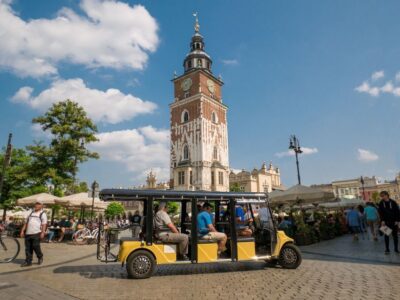 ★ 4.5City Sightseeing Tour by Electric Golf CartFrom $133,264 reviews
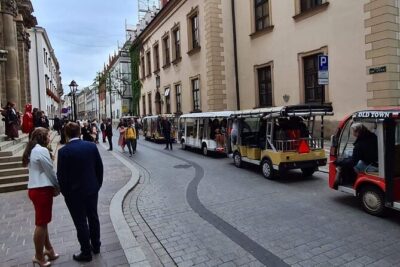 ★ 4.7City Sightseeing Tour Eco Electric Buggy Golf CartFrom $133,143 reviews
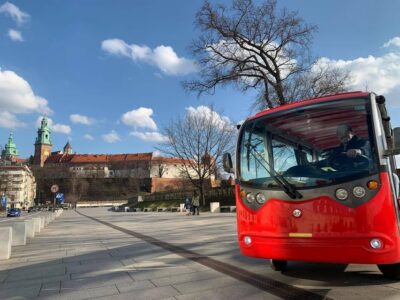 ★ 4.7Extended City Sightseeing Tour – Eco Buggy Golf CartFrom $13794 reviews
 ★ 4.4Electric Car Sightseeing TourFrom $25450 reviews
 ★ 4.6Jewish Quarter and Ghetto Electric Golf Cart TourFrom $34348 reviews
 ★ 5.0Krakow Grand City Tour by golf cart – All 3 districtsFrom $27311 reviews
 ★ 4.9City Tour by Electric Golf CartFrom $36310 reviews
 ★ 4.6City Tour of 3 Districts by Electric CarFrom $107217 reviews