
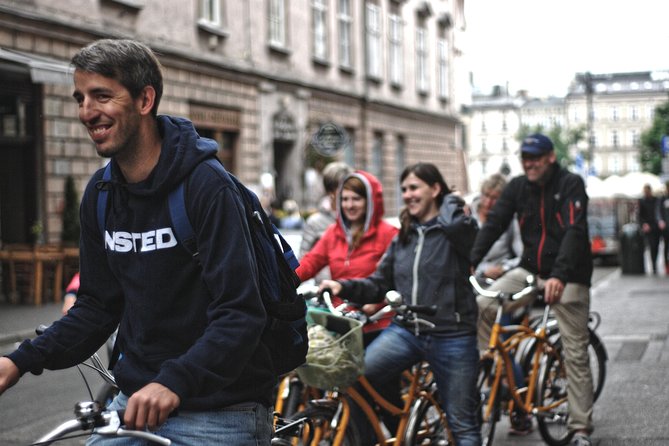
Review · KRAKOW BIKE & E-BIKE TOURS
Highlights of Krakow Bike Tour – Small group
Krakow is best when you move. This small-group bike tour is a smooth way to cover major sights in about four hours, starting at the huge medieval Rynek Główny and rolling through the university quarter, Wawel area, and into the Jewish Quarter and former ghetto zone. I especially like how the ride stays easy and practical, with flat routes and frequent stops, so you can actually see and not just get transported from one photo spot to the next. I also love the storytelling style, with guides who connect landmarks to the city’s bigger chapters, including the Wawel royals and the Jewish history around Kazimierz and WWII-era sites. One drawback to keep in mind: this is weather-dependent, so if it is truly foul, you may need to switch dates.
You will start in the center of Krakow at the Adam Mickiewicz Monument by Rynek Główny, then glide along the city’s historic green belt, Planty Gardens, before heading toward Poland’s oldest university, Jagiellonian University. From there it is a classic mix of architecture, legends, and hard history, with a lunch break in Kazimierz where you can choose your own meal. The small group size matters here, because you get a pace that feels organized rather than rushed.
The ride is also a great “day one” plan. It helps you learn the layout fast, so later you can pick neighborhoods and sights you want to revisit, like the quieter corners around the squares and streets.
Key highlights that make this bike tour work
- Small-group size (max 15) keeps the pace friendly and the guide able to answer questions.
- Flat, bike-first route around major sites, with frequent photo stops so you do not feel sprinted through.
- University Quarter + Planty Gardens gives you the city’s “everyday Krakow” green ring before the big monuments.
- Jewish Quarter and ghetto-area landmarks are part of the route, with stops designed to help you understand what you are seeing.
- Comfortable bike rental and practical extras like a rain poncho if needed.
Entering Krakow by bike, not by hopscotch
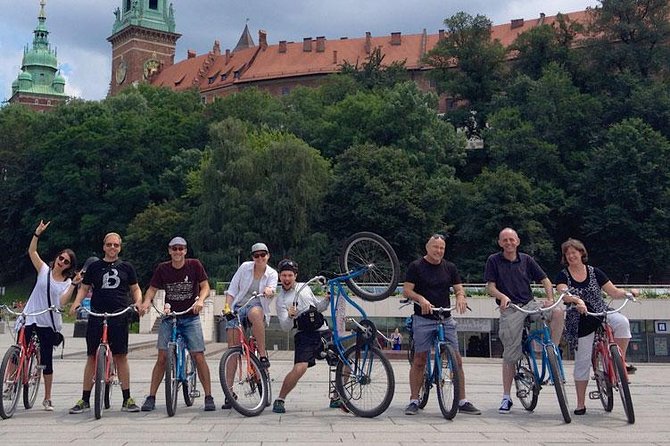
Meeting at the Adam Mickiewicz Monument near Rynek Główny is convenient because this is where your first day in Krakow will naturally funnel you anyway. You also get a quick setup period at the tour office nearby, which matters if you want to feel confident before you pedal off into the city’s streets and cycle paths.
Bikes are provided, so you do not need to hunt for rentals or worry about the quality of the ride in advance. And because the ride is designed for sightseeing, the stops are built in rather than optional. That means you can focus on looking and listening, not on when you will find the next parking spot, ticket line, or landmark.
What I like most is how the tour behaves like a map with explanations. You are not just seeing “cool buildings,” you are learning why they mattered and how the city organized itself around power, faith, education, and survival. That is the difference between collecting sights and building a mental picture of Krakow.
One other small but real advantage: riding is often more comfortable than walking in warmer weather. Multiple guides and many riders note that biking is pleasant compared to doing everything on foot, especially when you want to cover a lot without feeling drained by the end.
You can also read our reviews of more cycling tours in Krakow

Rynek Główny and Planty Gardens, the start of the story
Your first big stop is Rynek Główny (Central Square), the enormous medieval square that still anchors the Old Town. Even if you have already seen pictures, the scale is hard to get from a screen. Getting here early on a bike tour helps, because you see how the square connects to streets, churches, and the flow of people.
From there you head toward the Planty Gardens, a long green belt that circles the Old Town. This part is not just scenic. It gives you a calmer pace between the major monuments, and it helps you feel the rhythm of the city as it transitions from dense medieval streets to more open views.
Planty is also a smart reset point. In a few minutes, you move from “I need to orient myself” energy to “I get it now” energy. You start noticing alignments, sight lines, and how Krakow’s historic core is laid out.
Along this early stretch, you will be walking your bike just enough when needed, then rolling again. It is a sightseeing rhythm, not a training ride. That makes it a good choice if you are traveling solo, with a partner, or with teens who can handle basic biking but do not want a hardcore workout.
Past the city walls: Barbican to the university core
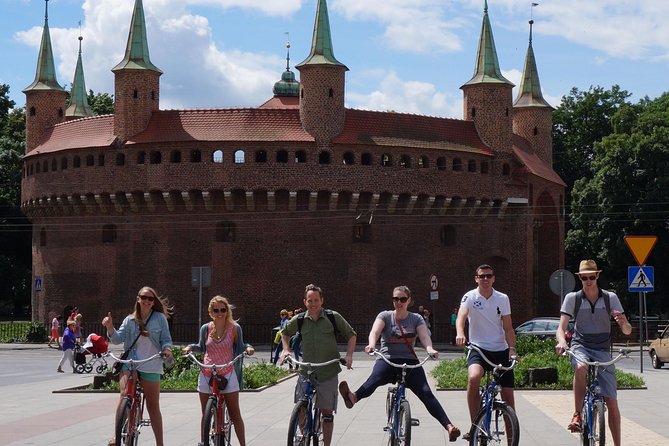
Next up is the Barbican area and the museum of Krakow, which connects you with the city walls and defenses. This is one of those moments where the bike makes sense. You can keep moving while still taking in the fortification mood and the way Krakow protected its historic center.
Then the route pushes into the University Quarter, and it is here that the tour becomes very “Krakow.” You pass major university landmarks, including Jagiellonian University, founded in the 1300s and described as Poland’s oldest university. The guide points out why this matters: universities here were not just schools, they were institutions that shaped culture and politics.
You also get a stop at Muzeum Uniwersytetu Jagiellonskiego Collegium Maius, with attention on the courtyard and clock at Collegium Maius. Even if you do not go inside any building, this stop helps you connect the legend of learning with the real physical space where it happened.
A nearby highlight is University Collegiate Church of St. Anne in Krakow. The guide ties it to Jewish history in Krakow, which adds context that many visitors miss if they only think of churches as purely Christian-era landmarks. You come away seeing how Krakow’s religious and cultural layers overlap in the same neighborhoods.
Another stop that adds a human dimension is Bishop’s Palace, tied to the history of Pope John Paul II. You are still in “look at impressive architecture” mode, but with a specific thread to follow.
Wawel Castle and the dragon legend
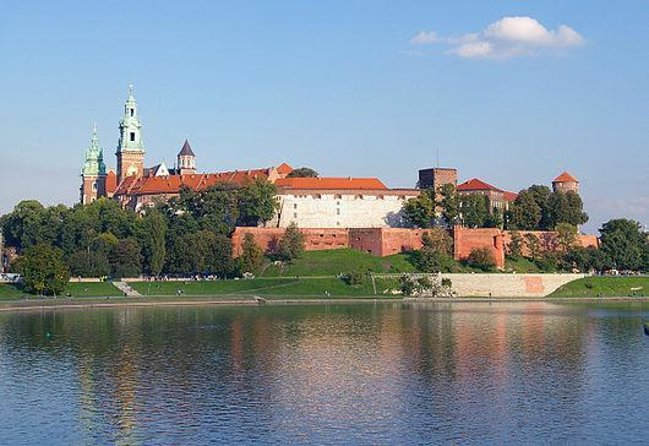
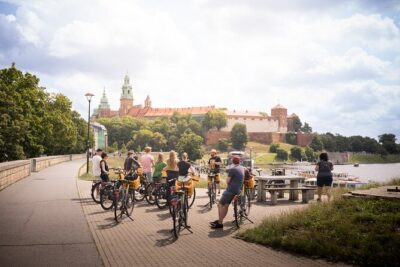
The route reaches Wawel Royal Castle, the long-time seat of Polish royalty and today one of the country’s major art museums. Even a quick bike stop gives you a strong sense of the site’s authority and how it sits above the city. If you are used to grand palaces being off in the distance, Wawel feels different because it dominates your sense of orientation.
Then you get the lighter side of the story with the Monument of the Wawel Dragon. It is not just a goofy photo. In Krakow, legends like this sit beside royal history, and the guide uses that contrast to keep the tour balanced.
If you are the type who gets bored by straight-line history, this is where the tour stays fun. You are still learning, just with variety.
This section also sets you up for the transition toward the Vistula River, and later the WWII-era landmarks. In other words, the tour does not treat history like a single theme. It treats it like an ongoing place.
Along the Vistula, then into the WWII-era ghetto area
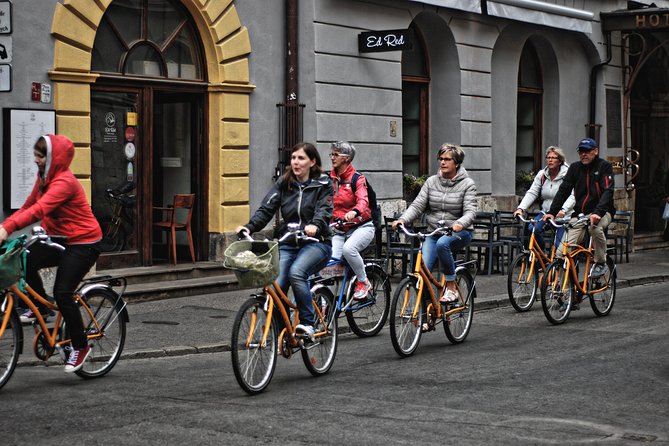
You bike along the Vistula River, and that matters more than it sounds. It is a visual break that helps you absorb the city after dense Old Town streets and before more emotionally heavy stops. It also adds a sense of geography, because the river and surrounding districts shaped how Krakow functioned.
Then comes the serious part: entering the Krakow Ghetto area. You stop at Plac Bohaterow Getta, which is tied to the Podgórze district and the WWII ghetto. You also see a ghetto wall fragment, a concrete remnant that helps you understand this was not just a concept or a distant event.
One of the strongest stops here is the Oskar Schindler’s Enamel Factory, connected to Schindler and his famous list. The guide’s job at this point is not to overwhelm you, but to help you place the landmark into the broader story of how individuals and decisions shaped survival.
A good sign of a well-run tour is how it balances gravity with structure. Here, you get a sequence of stops that build understanding step-by-step, rather than a single stop that you are meant to interpret alone.
Kazimierz stops: cemeteries, synagogues, and the everyday Jewish streetscape
After the ghetto-area segment, the tour shifts toward Kazimierz, the older Jewish quarter of Krakow. You get multiple stops that help you move from the WWII framework into longer, deeper community life.
You might pause at the New Jewish Cemetery, then move toward the Szeroka Street area, known as a historic Jewish street in the heart of Kazimierz. This is where the tour feels most like you are wandering a living neighborhood, not just visiting a memorial.
Then you reach major landmark stops such as the Old Synagogue and Remuh Cemetery. Together, these stops help you connect architecture, sacred spaces, and the cemetery tradition to the people behind the history. Even if you are not a history buff, these moments tend to land because they are physical places you can stand in.
This is also where you may notice the pacing. A small-group setup means the guide can slow down when the group needs a minute, especially around emotionally intense sites. In the best moments, it feels respectful without feeling stiff.
Lunch in Kazimierz and the best kind of free time
At some point you will stop for lunch at an authentic Polish restaurant, with food and drinks at your own expense. That break is not filler. It is your reset so you can keep the tour energy for the later stops, especially if the day is hot.
One practical tip: since your lunch is not included, you are free to pick what fits your budget and appetite. If you are riding all morning, this is also when I like to plan a lighter meal so you do not feel sluggish later in the afternoon.
The tour later continues back toward the central areas, but lunch is a turning point in the experience. It breaks up the heavier historical sections and gives you a bit of normal travel life, which is exactly what you want on a half-day.
Wrapping up at squares and the Slowacki Theatre feel
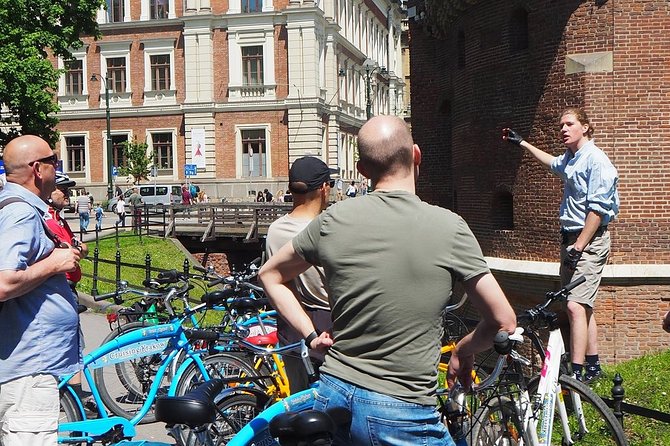
On the way back, you pass by lively squares and classic photo viewpoints. You will stop at Plac Nowy, which is known for pizza baguettes and has a more party-side feel. Then there is Little Market Square (Maly Rynek), a smaller square that still has that tight Old Town charm.
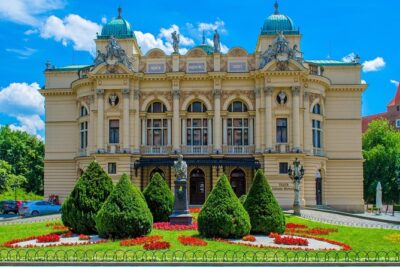
Finally, you reach Slowacki Theatre, described as a favorite piece of architecture in town. Even if you just view it from outside, it is a satisfying capstone because it shows another side of Krakow: artistic and modern cultural life layered on top of the medieval center.
In about four hours total, you are basically getting a tour that covers multiple “Krakow versions.” Old Town gravity. University energy. Royal Wawel presence. WWII-era reality. And then the Kazimierz streetscape and theater-side atmosphere.
Bike comfort, safety, and why the route feels easier than you expect
The bikes are set up for casual cycling on flat roads, and the tour description specifically talks about cycling on a beach cruiser style. In practice, you should expect an easy going ride with plenty of stops and a pace designed for sightseeing, not speed.
Comfort comes through in the setup and the breaks. Many riders point out comfortable seats and that the ride feels safe, even with occasional road sections mixed into cycle-tracks. If you are worried about traffic, keep in mind that the route is planned for biking, so it is not just steering you onto the busiest streets.
Because Krakow’s historic center includes cobbled areas, it helps that the tour bikes and route are chosen for stability. Also, you will not be stuck riding for long stretches without context. Stops are frequent, so you are rarely fully “in the ride mode.”
If you are traveling with kids, the tour notes that bikes are suitable for children over 128 cm. That is a helpful baseline. It also means you should look at your child’s height rather than their age when deciding if the bike will fit well.
Price and value: what $36.28 buys you
At $36.28 per person for about four hours, this is strong value because bike rental and a city guide are included. That matters in cities where renting decent bikes on short notice can cost you time and money.
You also get practical extras like a rain poncho if necessary, which is not flashy but genuinely useful. The tour includes a mobile ticket, and that saves you from printing or digging around for paper confirmations once you arrive.
Most importantly, you get organized coverage of the city’s big storylines. You start at Rynek Główny, you connect Planty Gardens to the university quarter, and then you pivot into Wawel and the Jewish Quarter plus ghetto-area sites. That is a lot of “first day orientation” for a half-day.
Finally, the small-group cap of 15 travelers is part of the value. It keeps the ride calmer and the guide more responsive. If you prefer asking questions and hearing explanations instead of listening over a crowd, this format fits well.
Should you book this Krakow bike tour?
I think you should book this tour if you want a smart first-day orientation and you like covering ground without feeling rushed. It is also a good fit if you want both the fun side of Krakow, like squares and theater architecture, and the necessary side, like the Jewish Quarter and WWII ghetto landmarks, presented with a clear sequence.
Book it if you are comfortable biking on flat routes and want a guide who tells the story behind what you see. If you prefer slow wandering with no structure, you might find the pace a lot. And since the experience requires good weather, have a flexible mindset for rain or heavy clouds.
If you want the fastest way to learn Krakow’s layout and pick where to spend your next days, this small-group bike tour is an efficient, friendly way to start.
FAQ
How long is the Krakow bike tour?
It lasts about 4 hours.
What does the price include?
The tour includes bike rental, a city guide, and a rain poncho if necessary.
Where do we meet for the tour?
The meeting point is the Adam Mickiewicz Monument, Rynek Główny, 31-042 Kraków, Poland.
Is the tour suitable for children?
Bikes are suitable for children over 128 cm height, and most travelers can participate.
Is lunch included?
Lunch is available at an authentic Polish restaurant stop, but food and drinks are not included, so you pay your own expense.
What language is the tour offered in?
The tour is offered in English.
What happens if the weather is bad?
The experience requires good weather. If it is canceled due to poor weather, you will be offered a different date or a full refund.
More Cycling Tours in Krakow
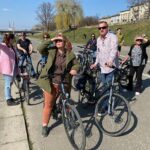
More Tours in Krakow
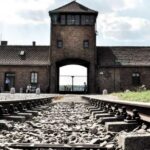
More Tour Reviews in Krakow
Not for you? Here's more nearby things to do in Krakow we have reviewed
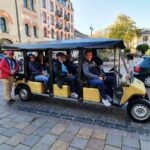

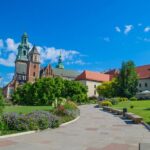





More Krakow Bike & E-Bike Tours to consider.
 ★ 5.0Complete Cracow Bike Tour (small group of maximum 15 people!)From $391,322 reviews
 ★ 4.9Bike Tour of Old Town, Jewish Quarter and the GhettoFrom $371,155 reviews
 ★ 5.0Full Bike Tour – the Old Town, Jewish Qtr & the Ghetto NEW BIKESFrom $35437 reviews
 ★ 4.9Bike Tour of the Old Town, Kazimierz, and the GhettoFrom $26350 reviews
 ★ 5.0Hidden Krakow Bike TourFrom $39275 reviews
 ★ 5.0Private Bike Tour in KrakowFrom $151152 reviews
 ★ 4.83-Hour Small Group Tour on E-BikeFrom $62135 reviews
 ★ 4.9Complete Bike tour with all the highlightsFrom $4890 reviews
Other ways to explore Krakow