
Review · OLD TOWN & MAIN SQUARE TOURS
Kazimierz District, the Wawel Hill and Cracow Old Town
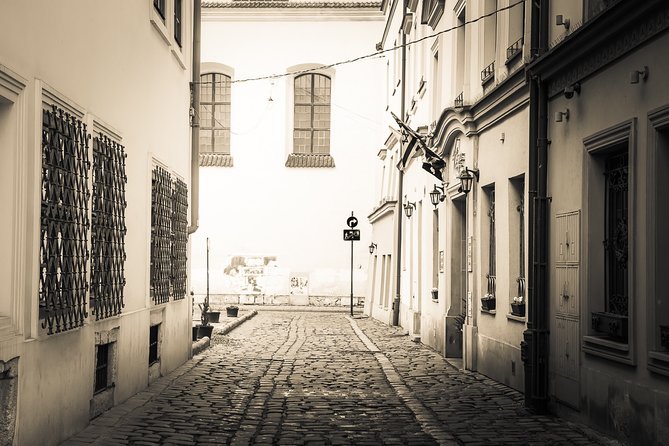
Krakow hits different when you walk it. This half-day route threads together Kazimierz and the Wawel Hill and Old Town highlights in a way that makes the city feel like one story, not a grab bag of sights. I like that the tour leans on the real geography, starting on Szeroka Street and ending at the Kraków Barbican. I also like the practical whisper system, which helps you keep up without craning your neck. The one thing to consider is that parts of the most famous buildings are optional, so you may need extra entry tickets if you want inside views.
The other reason this works so well is pacing. You get enough time at each stop to understand what you are seeing, then you move on while the streets are still doing their thing. The total walk is manageable for most people, but it is not recommended if you have impaired mobility, since it is a walking tour through uneven historic streets.
Key things to know before walking Kazimierz to the Barbican
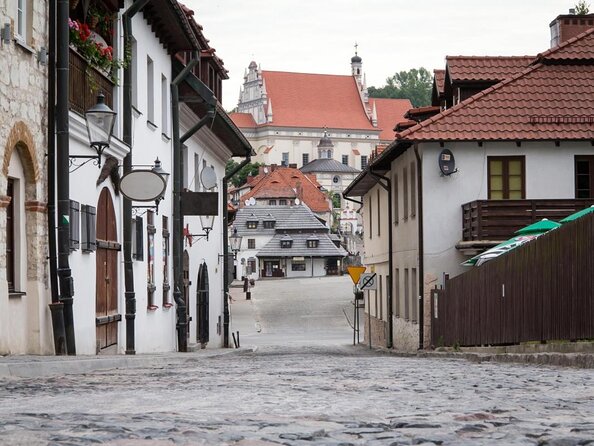
- Start on Szeroka Street, in the former Jewish district since 1800, so you set the historical context early
- Use the whisper system, a big deal when you want to hear details in crowded Old Town streets
- Expect optional interiors at Remuh, Wawel Cathedral, and St Mary’s Basilica, with admission not included for those stops
- Catch the Schindler’s List patio scene location while you are already in Kazimierz, not as a side detour
- Get inside big names for free like the Cloth Hall visit and the university-quarter stops
- End at the city walls, near Saint Florian’s Gate and the Kraków Barbican, so your last minutes feel dramatic and “finished”
Why Kazimierz plus Wawel makes the best use of 4 hours
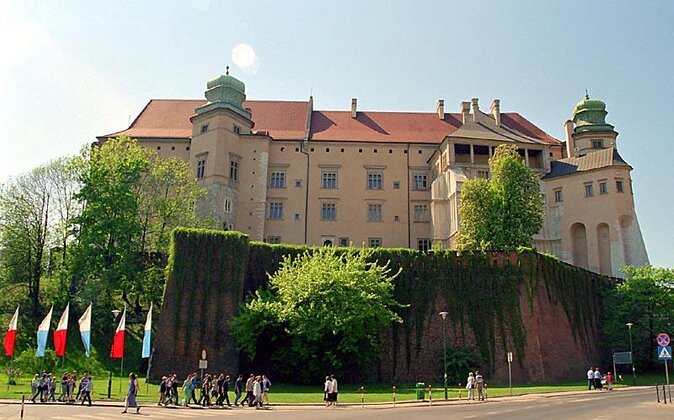
This tour is built for people who want the “core Krakow” experience without spending the whole day on trains of tickets. You start in Kazimierz, the former Jewish district and a major cultural and political center along Szeroka Street for centuries. Then you climb into the Wawel Hill storyline, where royal power, art, and Polish identity meet. After that, you flow naturally into the Old Town with stops that anchor you at the Main Market Square and St Mary’s Basilica area.
Timing matters here. Each segment is short enough to keep energy up, but not so short that you only see postcard angles. You also get a mix of exterior views and optional interior visits, so you can choose how “deep” you go based on your budget and your legs.
If you like city tours that explain what you are looking at in plain terms, this one fits. If you want a slow museum day with long lines and long sits, you might feel rushed. But for 4 hours, the balance is strong.
You can also read our reviews of more tours and experiences in Krakow.
Szeroka Street, Remuh Synagogue, and the cemetery still doing their job
You kick things off at Remuh Synagogue, in the Kazimierz area. This is your first real taste of how old Krakow’s Jewish community roots are, and it sets the tone for everything that follows. The synagogue is from the 16th century, and the adjacent Jewish cemetery is from the same period too. The cemetery is described as one of the oldest Jewish cemeteries in Europe.
What to watch for is not just the building look, but the idea that this is a place of memory and continuity. The information you get highlights that it is the eternal resting place of Jewish sages including Rabbi Moses and Natan Spira. That context helps when you later spot other synagogues and courtyards around the district.
Note the timing and practical side: you get about 20 minutes at this stop. Entry into the synagogue and cemetery is optional, and admission is not included. If you choose to go inside, plan a little extra mental space, because this is a reflective stop, not a “quick photo, next!” moment.
Isaac’s Synagogue area and the Schindler’s List courtyard angle in Kazimierz
Next you move through Kazimierz on foot, with your guide pointing out key landmarks along the way. You pass near Isaac’s Synagogue and cross Nowy Square, then reach a well-known courtyard patio between Józefa and Meiselsa streets.
That courtyard is famous because it appears in Steven Spielberg’s Schindler’s List. The point is not to treat it like a film set and move on. What you want is the framing: you are standing in a living neighborhood with layers of Jewish life behind it, and the “movie location” becomes a gateway to the real history of the area.
You get about 45 minutes in this broader Kazimierz segment. Admission for this portion is listed as free, which matters because it keeps your budget predictable while still giving you time for the atmosphere and the details.
Tip: if you are the type who likes to walk slowly for photos, this is the section where you can slow down without throwing off the rest of the day. Just keep an eye on the group and the meeting point rhythm.
Wawel Hill Royal Castle patio, Renaissance style up close
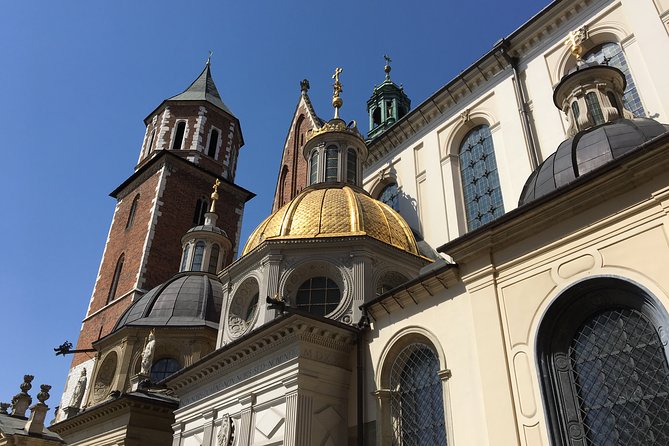
After Kazimierz, you shift to Wawel Hill, and the city changes mode. You are no longer in neighborhood lanes. You are moving into a viewpoint zone tied to royal power and Renaissance art.
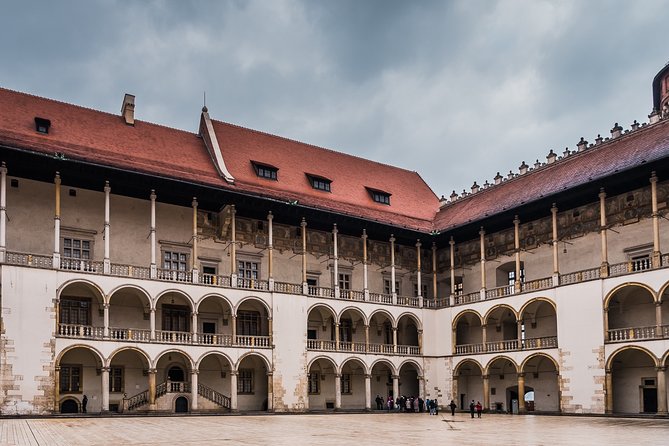
At the Royal Castle stop, you admire the patio connected to the castle and the design is described as a Renaissance masterpiece, with named contributors Francesco Fiorentino and Bartolomeo Berrecci. Even if you do not go deep into additional rooms, the patio view is enough to help you understand the scale and style of the complex.
This stop is about 15 minutes, and admission is listed as free for what you do here. That is a good deal. You get a high-impact landmark without paying extra just to look at the exterior architectural face.
Practical thought: wear shoes you trust. Wawel and the Old Town are beautiful, but cobbles and steps can be a test if you have soft soles or brand-new shoes.
Wawel Cathedral, coronations, and why kings chose this exact hill
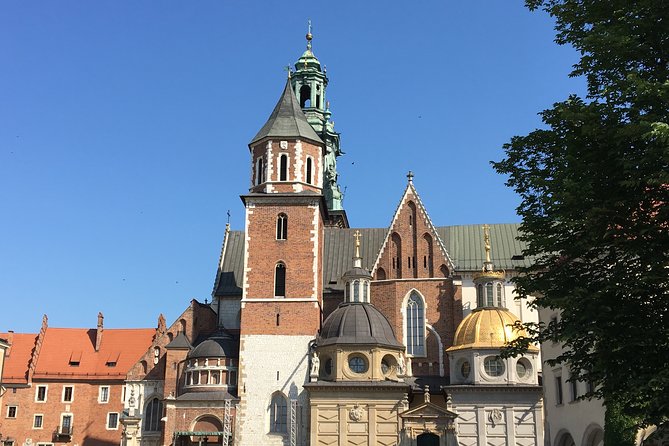
The next stop is Wawel Cathedral, dedicated to Saint Stanislas and Saint Venceslas. This is the “why this hill matters” moment, because the cathedral is more than a pretty church stop.
You learn that the cathedral has more than one thousand years of history. It served as the place of coronation for Polish kings, and it is also connected to royal burials. That helps you read the building with purpose rather than only as architecture.
Entry is optional and admission is not included. The time at this stop is about 40 minutes, so you can decide how much “inside time” you want. If you like cathedrals, coronation stories, and the feeling of dynasties leaving traces, go in. If you prefer to keep things budget-friendly, you can still appreciate the area while keeping your spending under control.

Franciscan basilica area, Wyspiański stained glass, and oldest streets in view
Now you walk down some of Cracow’s older streets, including Kanonicza and Grodzka, to reach the Gothic basilica of the Franciscan friars. This part gives you a different texture than the royal and university zones.
You are here to admire polychromy and modernist stained glass windows attributed to Stanislas Wyspiański. That mix is the point. You get Gothic structure plus later artistic layers, which makes this stop feel like a timeline you can stand in, not a single snapshot.
This section is about 15 minutes and the stop is listed as free for the experience described. Right after, you head into the university quarter.
One small planning note: stained glass can be light-dependent. If the weather is flat or rainy, the visual punch might vary, so use your time with your guide to focus on the storytelling, not only the color.
Collegium Novum and the Jagiellonian University buildings where Copernicus studied
After the Franciscans, you enter the university quarter and see Collegium Novum, a 19th-century building that is the seat of the rector of the Jagiellonian University. From there, you move to medieval buildings connected with the older university.
The Jagiellonian University is described as being funded in 1364 by King Casimir the Great. You also learn that Collegium Maius is the oldest university building from the 15th century. And yes, this is where Nicolaus Copernicus, the famous Polish astronomer, studied.
This is not a “sit in a lecture hall” kind of stop. It is more about walking through the academic setting and understanding how long the institution has been part of Cracow’s identity.
Time-wise, you get about 10 minutes at Collegium Novum, and about 15 minutes at the Jagiellonian University medieval buildings. Admissions are listed as free for the described stops, which keeps the value strong.
If you care about science history, this is one of the sections that makes the city feel bigger than old stones. Krakow is not just medieval. It is also where learning kept going.
Main Market Square and Cloth Hall: from Mongol recovery to textile power
Then you hit the big center: Rynek, the Main Market Square. It is described as the largest medieval square in Europe, and it dates back to 1257. The layout followed a disastrous Mongolian invasion that ravaged Krakow in 1241. That kind of cause-and-effect adds weight to what might otherwise feel like “just a square.”
You also enter the Cloth Hall, an old textile market dating back to the 13th century. The building was remodeled in the 16th century thanks to Santi Gucci, a Florentine artist. This matters because you are not only looking at a square where people gathered. You are looking at a place where trade and wealth were physically organized.
This stop is about 30 minutes and admission is listed as free for what you do here. That is a good value chunk in the tour. You spend time in the center where you can orient yourself for the rest of your day, even if you plan to continue exploring after the tour ends.
Tip: pause near the Cloth Hall entrance and let your guide finish the story. The square is busy. You will absorb more if you line up the timeline first, then look around.
St Mary’s Basilica area, Veit Stoss altar, and the Hejnał hourly call
From the Main Market Square area, you reach St Mary’s Basilica. Entry is optional and admission is not included.
You learn that St Mary’s Basilica was the most important church for the city’s bourgeoisie, so it is tied to the middle-class story, not just royal power. Inside, you can find the impressive wooden High Altar from the 15th century, carved in linden wood by the German artist Veit Stoss. The altar includes scenes from the lives of the Virgin Mary and Jesus Christ. It is described as a Gothic masterpiece, and this is one of the stops where choosing to go in can pay off.
Right beside the basilica, you get a chance to experience the hourly Hejnał, an old melody played each hour four times from the highest tower of the church. This is one of those Krakow signatures that makes the city feel alive even when you are moving.
Time-wise, St Mary’s Basilica is about 20 minutes with optional entry, and the Hejnał stop is about 10 minutes with free access for the experience described.
Practical advice: if you are timing your day around this, the Hejnał is tied to the hour. Since the tour starts at 9:30 am, you are likely to catch one of these moments, but you will still want to keep your schedule flexible.
Kraków Barbican and Saint Florian’s Gate: finishing at the city wall edge
Your walk ends near the city walls at the Kraków Barbican area. You go along Floriańska Street and finish by Saint Florian’s Gate and the adjacent Barbican. The walls here date back to the 14th century, and the final view gives you a different kind of satisfaction than another church courtyard.
This is where the “old city defenses” story clicks. You stop moving forward through the neighborhoods and start seeing the boundaries that shaped how Krakow grew.
The stop is about 20 minutes and admission is listed as free for the described portion. The tour ends near Kraków Barbican at Basztowa, which is a great position for continuing on your own if you still have energy.
Price and value: what $65 buys you in real terms
At $65 for about 4 hours, this is not a “cheap wandering” tour. But it also is not built like a museum pass. You are paying mainly for interpretation, timing, and a smooth walking flow that connects the dots between Kazimierz, Wawel, and the Old Town.
The big included value item is the whisper system, which helps you hear your guide clearly. That one detail can change the whole tour experience, especially in places where streets get noisy.
What is not included is also part of the value equation. Bottled water and drinks like coffee, tea, and soda are not included. Also, optional admission is not included for Remuh Synagogue, Wawel Cathedral, and St Mary’s Basilica. If you want all three interiors, your total spend will rise. If you pick and choose based on your interests, the tour stays good value because many of the best landmark stops are free for the activities you do.
My practical suggestion: plan to bring a small snack or money for a drink. You will save yourself from the “I need water right now” scramble during the most crowded streets.
Should you book this Krakow walk from Kazimierz to Wawel?
Book it if you want a half-day route that connects major Krakow areas with context. This is ideal for first-timers who feel overwhelmed by a city with so many sights, but it also works for return visitors who want a clearer story between neighborhoods, royal sites, and civic spaces.
You should think twice if mobility is an issue, because the tour is described as not recommended for travellers with impaired mobility. Also, if you only care about inside museum-style time, you might feel the optional interiors are the limiting factor, since some of the most famous buildings require extra admissions.
If you like a guided day with strong landmarks and practical listening support, this is a smart way to get your bearings fast.
FAQ
How long is the Krakow Kazimierz and Old Town tour?
It runs for about 4 hours.
What time does the tour start, and where do we meet?
The start time is 9:30 am. The meeting point is Szeroka 40, 31-053 Kraków, Poland.
Where does the tour end?
The tour ends near Kraków Barbican at Basztowa, 30-547 Kraków, Poland.
Is the whisper system included?
Yes. The tour includes a whisper system for a better experience during the visit.
Which entrances are optional, and are they included in the price?
Remuh Synagogue and its adjacent cemetery are optional, and admission is not included. Wawel Cathedral entry is optional and admission is not included. St Mary’s Basilica entry is optional and admission is not included.
Are any major sights included for free?
Yes. Stops like Kazimierz courtyard areas, Wawel Royal Castle patio view, Franciscan basilica area, Collegium Novum, Jagiellonian University buildings, Main Market Square with the Cloth Hall visit, the Hejnał experience, and the Kraków Barbican area are listed as free for the tour stops.
Is bottled water or drinks included?
No. Bottled water and coffee or tea are not included, and soda or pop is also not included.
Is it a private tour?
It is a private tour or activity, so only your group participates.
What is the cancellation window?
You can cancel for a full refund up to 24 hours before the experience’s start time. If you cancel less than 24 hours before, the amount paid is not refunded.
More Tour Reviews in Krakow
Not for you? Here's more nearby things to do in Krakow we have reviewed






More Old Town & Main Square Tours to consider.
 ★ 5.0Old Town Krakow & Wawel Castle Walking TourFrom $261,508 reviews
 ★ 4.9Bike Tour of Old Town, Jewish Quarter and the GhettoFrom $371,155 reviews
 ★ 4.8The Old Town Walking TourFrom $19794 reviews
 ★ 4.7Old Town Guided Segway TourFrom $55756 reviews
 ★ 4.8Old Town & Wawel Castle Walking Tour in EnglishFrom $26532 reviews
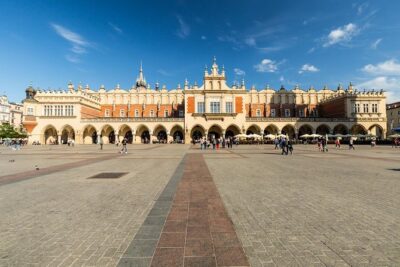 ★ 4.5Krakow Old Town Guided Walking TourFrom $33438 reviews
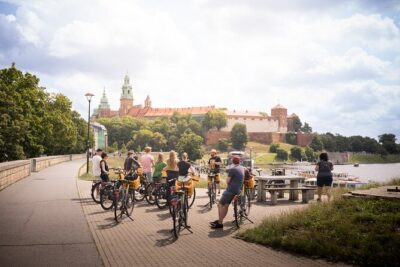 ★ 5.0Full Bike Tour – the Old Town, Jewish Qtr & the Ghetto NEW BIKESFrom $35437 reviews
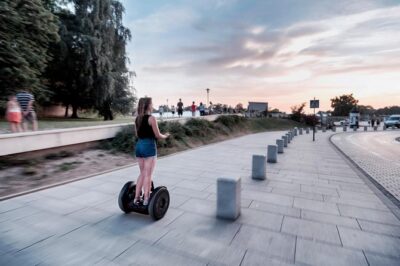 ★ 5.0Krakow Old Town Segway Tour 2hr with Training, Safety Gear, GuideFrom $57435 reviews
Other ways to explore Krakow